MILP / CP
Where structure is well understood and constraints dominate.
This page describes what Qbitune is researching and how we intend to evaluate it. It is a statement of a research direction, not a report of results. Where a capability has not been demonstrated, the text says so.
Real-world evidence becomes an explicit world model; a reason–abstract–plan engine works over that model; the result is compiled into formal problems, solved on heterogeneous compute, verified, and returned with an explanation. Environment changes re-enter the loop.
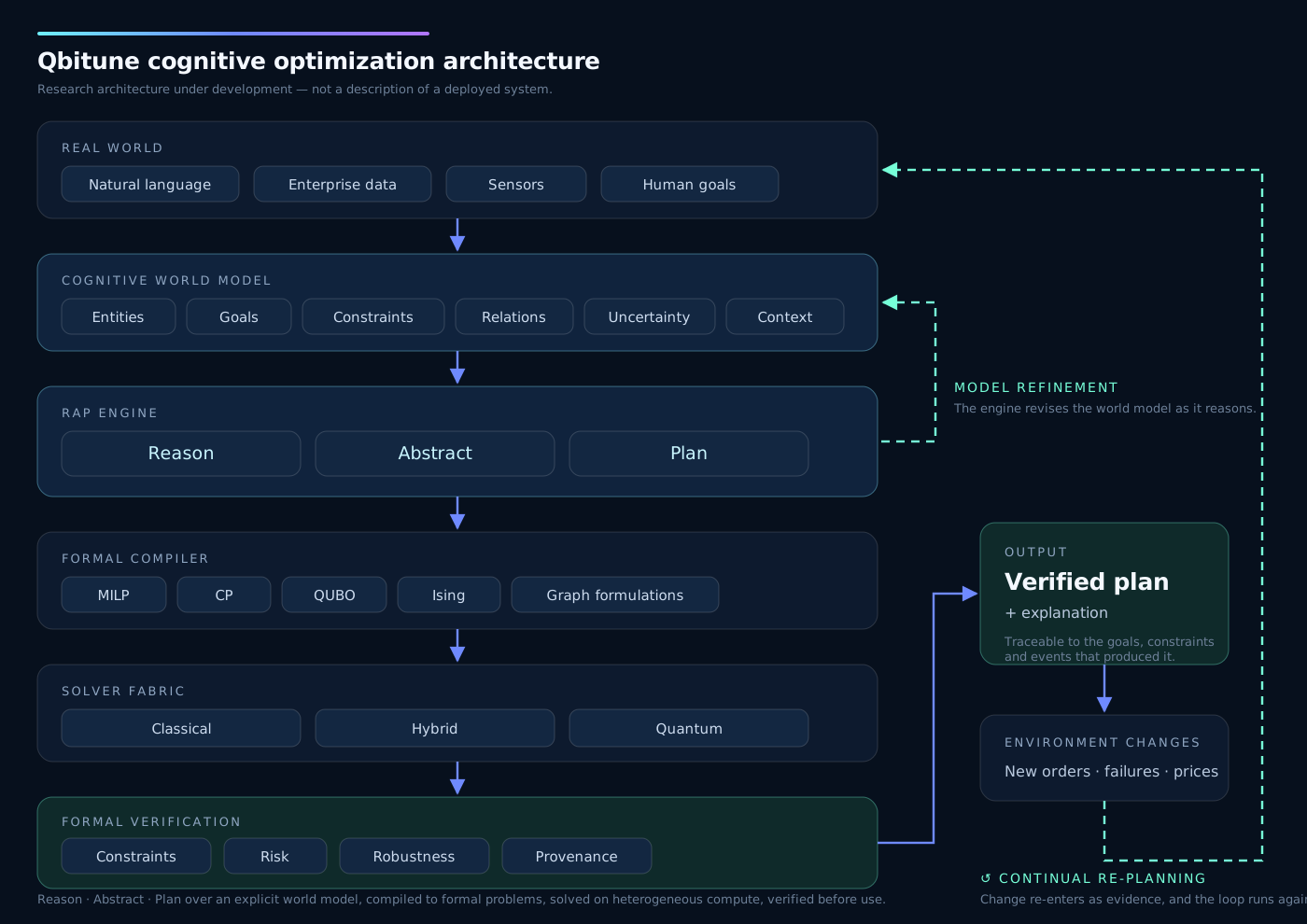
Each of these is an open question. None is a claim about what Qbitune can already do.
That a system can take an unstructured description of an operational situation and derive a formal decision problem that a solver can accept, without a human writing the model by hand.
That world models learned for one planning environment carry useful structure into a related one, rather than having to be rebuilt from nothing.
That hierarchical plans with explicit contingencies degrade more gracefully under disruption than plans recomputed from scratch.
That formal checks over hard constraints can be applied to machine-generated plans cheaply enough to sit in the loop before execution.
That selecting among classical, quantum-inspired, hybrid and quantum engines per subproblem beats committing to any single engine.
The cognitive layer should not be tied to a single mathematical representation. Which formalism suits a subproblem is itself a decision the system has to make.
Where structure is well understood and constraints dominate.
Where a problem reduces to binary quadratic form and annealing-style engines apply.
Where relations between entities carry most of the difficulty.
Where domain semantics do not survive translation into a standard form.
Trustworthiness has to be built into the architecture rather than asserted about it. These are the mechanisms the research is designed around.
Hard rules stay outside the learned components, where they can be tested.
Candidate plans are checked against those constraints before they are proposed.
Which goals, constraints and events drove the decision, in a form a planner can read.
Represented explicitly, so robust alternatives can be compared rather than assumed.
A trace of the data, model state and reasoning behind each plan.
Designed for research into transparent, accountable and human-centred cognitive AI. Qbitune makes no regulatory compliance claim.
Decompose long horizons so a local disruption does not invalidate the whole plan.
Carry alternatives for the failures that are likely rather than replanning blind.
Treat change as the normal case: monitor, revise, verify, repeat.
Qbitune is not based on the assumption that quantum computing is already superior for every optimization task. The cognitive layer should remain independent from the machine used to search for solutions.
Quantum when it helps. Classical when it wins.
A proposed evaluation framework. These benchmarks do not exist yet — building them is part of the work.
Logical and constraint validity.
Transfer and model correctness.
Plan feasibility and objective quality.
Performance after unexpected events.
Explanation fidelity and robustness.
Time, energy and computational resources.
We aim to contribute reusable benchmarks, evaluation protocols and interoperable interfaces for trustworthy cognitive planning.
Research outputs are intended to be Findable, Accessible, Interoperable and Reusable where the nature of the output allows it — with open interfaces for cognitive models, planners and solvers, and reproducible evaluation protocols.
Quantum Machine Intelligence, Springer (2026) · doi:10.1007/s42484-026-00441-1
Reformulates a hard optimization problem — training variational quantum algorithms — into a QUBO representation and solves it through a hybrid quantum workflow with recursive refinement. One concrete example of the capability Qbitune is generalising, not the limit of it.
Read on SpringerLink ↗A research plan, not a status report. Qbitune claims no current technology readiness level.
Formal representations and optimization research.
Reasoning, abstraction and planning architecture.
Verification, explainability and uncertainty.
Industrial planning demonstrator.
Validated at TRL4. This is the research target — not current status.
Qbitune is designed to be composable: to interoperate with other cognitive models, planners and solvers, and to take part in larger multi-system demonstrations rather than standing alone.
Open interfaces for cognitive models, planners and solvers.
Shared tasks and reproducible evaluation.
Composable technology for larger multi-system demonstrations.
Outputs designed around FAIR principles where applicable.
Potential synergies include European AI research infrastructures, testing facilities, HPC and quantum initiatives. Qbitune has no formal partnership to announce.
We are looking for research collaborators and industrial partners working on complex decision environments with changing goals, constraints and resources.